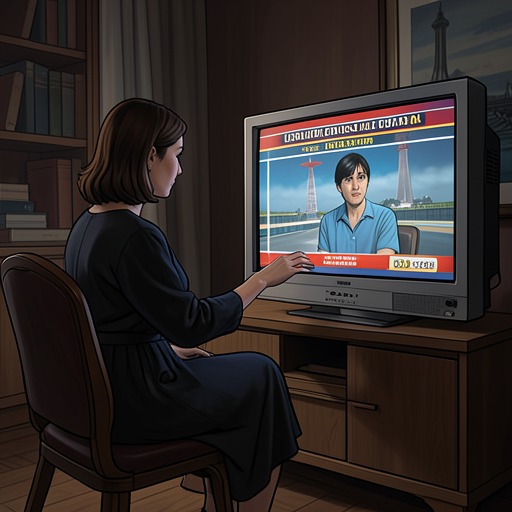
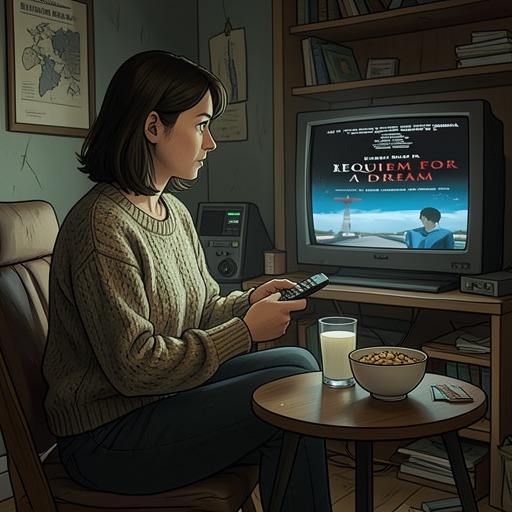
Sara receives a call about appearing on television
Requiem for a DreamSara receives a call about appearing on television when Lyle Russel of the McDick Corporation tells her she may become a contestant on a quiz show. The invitation is decisive less as a confirmed booking than as the opening of a new imagined future: after years of watching television as a refuge, Sara hears a voice from the medium address her personally and begins to picture herself on its screen. The call transforms an ordinary afternoon of viewing into the starting point of an increasingly consuming ambition.
Before the Call
Sara’s television habit has already shaped the terms in which she imagines a better life. She watches commercials and a soap opera from her viewing chair, taking in images of clean homes, attractive couples, and domestic happiness. A television dinner becomes part of that promise: she is pleased for the smiling couple on screen even as she checks her own money and realizes she will have to go without lunch to keep the set. In another program, a mother must decide whether to let a doctor operate on her son. Sara leans forward, anxiously urges the mother to agree, and settles back with the conviction that the operation will end well. Television offers both an ideal household and the certainty of a happy resolution—materials through which she also reassures herself about Harry Goldfarb.
When the phone rings, Sara is adjusting the antenna, torn between answering and correcting the lines that keep crossing the picture. She lets it ring repeatedly, reaching for the receiver while still trying to improve the television image, and lunges for it on the sixth ring. The small physical struggle establishes how completely the screen already commands her attention: even the possibility of a caller must compete with the picture.
The Invitation
The caller identifies himself as Lyle Russel of the McDick Corporation. His voice is so bright, cheerful, and professional that Sara turns toward the television, checking whether it is coming from there. Even after she recognizes that the sound is on the phone, she keeps one eye on the screen, looking between the two devices as she speaks. The scene makes the invitation feel as though television itself has reached out to her.
Russel describes a chance to appear on one of television’s quiz programs, then heightens the appeal by mentioning brand-new shows planned for the next season. His pitch presents participation as a rare distinction desired by millions of Americans. Sara responds with startled disbelief that she herself might be chosen. Russel offers no concrete explanation for her selection; instead, he tells her she must be fortunate and suggests that God has a special place in his heart for her. His promotional assurance supplies the emotional answer where the call supplies no practical detail.
The news overwhelms Sara before she can ask much about what will happen. She clutches the top of her dress and the receiver, stares wide-eyed, and falls back against her chair. Russel says that the necessary information will arrive in the mail, blesses her, and ends the call. The invitation is therefore real as a promise of further information, but the exchange establishes neither a particular program nor a broadcast date. Its immediate force comes from what Sara believes the opportunity means.
From Call to Preparation
After hanging up, Sara briefly struggles with the phone’s cradle before putting the receiver down. Her thoughts turn at once to appearance: what she can wear, whether her girdle will fit, whether she should stop eating, and whether she can lose thirty pounds before going on television. She considers having Ada do her hair, wonders whether the program will arrange it, and mentally inventories shoes, a handbag, earrings, a necklace, and a lace handkerchief. She also reconsiders the dress she thinks looks good on her, worrying that red may not show properly on screen.
The imagined appearance has already become a practical project, though the call has given her no confirmed schedule or instructions beyond the promise of mailed information. Sara gets up to search her closets, pulling dresses from hangers and laying them on the bed. She crawls into the darker corners to find forgotten shoes, dusts them off, and tries on pair after pair, wobbling as she tests them. The invitation redirects her from watching other people’s screen lives to preparing, urgently and without guidance, for a place in one of them.
The Invitation’s Afterlife
The call’s consequences extend far beyond the conversation. Sara continues to expect the television appearance even when Ada raises the possibility that something may have happened to the show. She wears her red dress and gold shoes, lets Ada touch up her hair, declines food, and keeps thinking about becoming thin. Friends who visit with pastries or bagels find her uninterested in eating and occupied with talk of television. She studies quiz programs so she will be ready for whichever show she might join.
Her imagined future grows more elaborate than Russel’s pitch. Sitting before the screen, Sara pictures herself answering questions with ease, receiving applause and gifts, and telling the audience that she will give the gifts to someone in need. In her fantasy, her success reaches the newspapers and the evening news, and people on the street celebrate her. The program has not yet appeared, but she experiences its imagined acclaim as a recurring private spectacle.
That fantasy also turns recognition into exposure. Sara imagines the television figures leaving the screen to inspect her shabby apartment, followed by an audience and cameras. She feels that millions can see her surroundings and know her shame; changing channels does not stop the images. Later she pulls down the shades, watches from behind the drapes, and listens at the door, alert to the possibility that someone is watching. The original call promises that Sara might be seen by a television audience as a contestant. Its darker development is her conviction that she is already being watched, while the actual invitation remains unfulfilled.